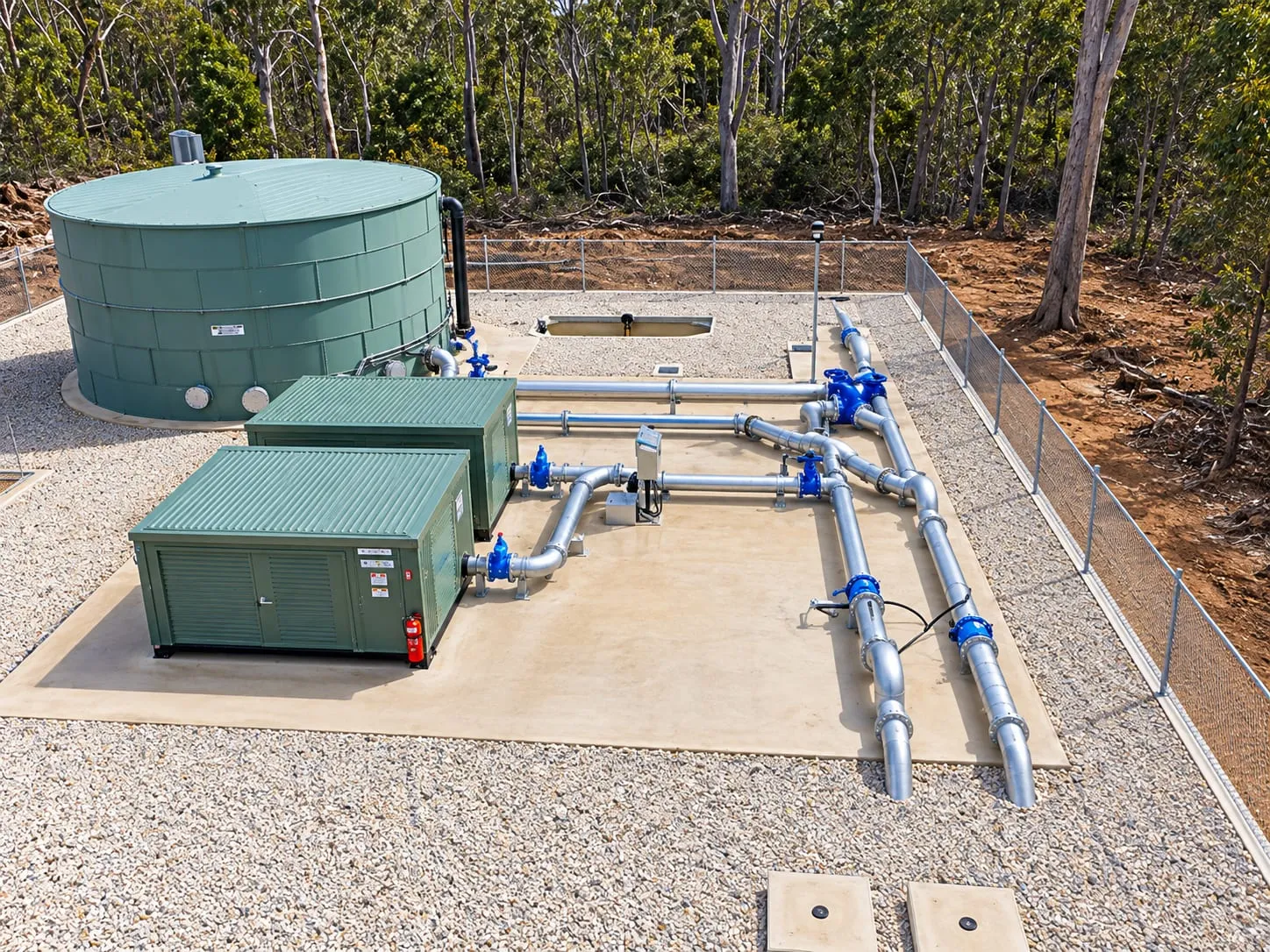
Water tank, equipment kiosks and above-ground pipework on a gravel pad at a bushland site
Water Management Systems

Water treatment plants

Aqua Energy Group designs and builds water treatment plants for mine sites, industrial facilities, councils and water authorities. Our plants handle process water, potable water, wastewater and wash bay recycling. Most are supplied as containerised water treatment plants that are compact, transportable and quick to connect on site.

We design each plant together with the pumps that feed it. We size storage, dosing and controls to match, so the whole water system works as one. We build plants in our own workshop and test them before dispatch, and customers can see them running before they ship. That means less on-site rework and a plant designed for low operating costs and simple maintenance throughout its life.

Choosing a water treatment process

The right treatment process depends on two things: what’s in your source water, and what the treated water is for.

What’s in the water. Suspended solids, oils, organic matter, dissolved salts, heavy metals and pathogens each call for different treatment, and many sites have a mix of them.

What the water is for. Process water, potable water, boiler feed, wash water reuse and discharge under licence all have different quality needs. Treating industrial wastewater for discharge is a different job to producing industrial process water.

Treatment Stages

A treatment process is usually built from stages

  1. Primary treatment

    Screening, settling and oil separation remove most of the solids and oils.

  2. Secondary (biological) treatment

    Breaks down organic loads, which matters for sewage and similar wastewater.

  3. Tertiary treatment

    Polishes the water through filtration, membrane filtration such as ultrafiltration and reverse osmosis, ion exchange and disinfection.

Most water treatment systems combine some of these stages, and the mix depends on your water and your target. Whether it's containerised sewage treatment or a larger industrial plant, we'll work back from what the water needs to achieve. Tell us your source water and how you plan to use it, and we'll help you choose the process.

Configurations

Containerised water treatment plants

A containerised water treatment plant puts the treatment equipment inside a transportable container, built in our workshop and delivered ready to connect. That makes containerised water treatment systems a good fit when you need capacity quickly, space is limited or your site may change. Most plants are tested in a controlled workshop before they ship.

  • Smaller flows

    Skid-mounted

    Compact packages for smaller flows, where a full container isn't needed.

  • Large, permanent plants

    Built in place

    For large, permanent plants where scale or site layout makes a custom build the better fit.

10, 20 and 40 ft
Container sizes we've supplied
IP55 minimum
Rating for outdoor components
Stainless steel
Construction available for harsh environments

Our modular approach means components are built and tested as they're completed, which reduces installation time on site. The same approach suits containerised wastewater treatment.

Integrated Design

Treatment designed with the water system around it

A treatment plant only works as well as the water system around it. We design the plant together with the pumping, storage and dosing that feed it and follow it, so the whole system suits your site, not just the equipment in the middle.

Mining and industrial process water

On a mine or industrial site, water moves between several stages: raw water from bores and storages, process water, contaminated runoff and discharge under licence. Our water treatment plant designs are built around that water balance, with pumping, storage and dosing planned in from the start. That suits industrial process water, and industrial wastewater that needs treating before it's reused or released. It's the same joined-up thinking we applied when upgrading the water management system at Centennial Coal, and our reagent and flocculant dosing plants show how dosing fits into the wider treatment process.

Councils and water authorities

When treatment capacity is needed quickly, a compact plant can help. A small footprint and a plant delivered ready to connect suit sites with limited space or tight timelines. It also suits industrial and municipal applications, where we design the pumping and storage alongside the plant.

Operating cost and whole-of-life design

The purchase price is only part of what a treatment plant costs. Over its life, the design affects how much energy the plant uses, how much chemical it needs and how much maintenance it asks of your team, so we design for the whole of life, not just the build. Choosing the right process, sizing pumps and tanks properly and planning for easy access to components all help keep running costs and maintenance in check.

Integrated controls bring the plant, pumping and dosing together, so the system runs consistently with less manual adjustment. Where it suits your site, remote monitoring gives you visibility of performance without needing someone on site. Tell us how your team operates and how much maintenance capacity you have, and we'll design the plant to fit.

Wash bay water treatment and recycling

Wash bays for mining workshops, large industrial vehicles and trucks produce water laden with solids, oils and grease. Our containerised wash bay tertiary treatment system is designed as a cost-effective solution for wash bay developments that must meet Australia's strict local authority standards, and it can gain authority approval because of its quantifiable treatment standards and engineering.

Water is collected at the washdown pad by an inlet pump station and passes through a coalescing plate separator for suspended solids, free oils and grease, media filtration for fine suspended solids, oil adsorbent granules for emulsified hydrocarbons, and flow-paced chlorine dosing for disinfection. An integrated control panel runs the plant automatically, with alarms for emergency stop, low water level, high filter differential pressure, low chlorine and pump fault. Options include effluent monitoring for chlorine, pH and turbidity, remote monitoring, storage tanks and a pressure washer. For the wash bay itself, see wash bay design and construction.

Features and benefits

Features

  • Containerised and modular plant design
  • Surface water, wastewater and wash bay water treatment
  • Selective removal and recovery of contaminants or minerals
  • Stainless steel construction for harsh environments
  • Minimum IP55 protection on all outdoor components
  • Proven components for system compliance
  • Integrated controls with remote monitoring options

Benefits

  • Reduced construction time and quicker return on investment
  • Very low operational costs and limited maintenance items
  • Factory testing with customer involvement
  • Minimal rework on site during installation
  • In-house engineering innovation
  • Compact, scalable solutions
Specifications

Containerised wash bay tertiary treatment system

ItemDetail
Enclosure40 ft A-grade shipping container
Dimensions (L x W x H)12,000 x 2,500 x 2,600 mm
FiltrationDown to 5 micron
Treatment stagesCoalescing plate separator, media filtration, oil adsorbent granules, chlorine dosing
Pressure pump0.5 L/s at 400 kPa
Power240 V 50 Hz 18 A, or 415 V 50 Hz 52 A with pressure washer
Optional pressure washer 4000 psi at 21 L/min, 11 kW three phase. Optional effluent monitoring for chlorine, pH and turbidity.

Frequently asked questions

What types of water treatment plant do you build?

We design and build water treatment plants, including containerised plants, for process water, potable water and wastewater. Typical applications include treating surface water for use on site, treating wastewater, recovering contaminants or minerals and wash water treatment. Plants can be containerised, skid-mounted or built in place, depending on your site and flow.

Do you build water treatment plants for councils and water authorities?

Yes. Our plants suit industrial and municipal applications, including our packaged sewer treatment plant at Newcastle. Tell us about your project, and we'll help you work out the right approach, along with the pumping and storage around the plant.

What are the advantages of a containerised water treatment plant?

It has a compact footprint and arrives ready to connect, and most plants are tested in our workshop before they ship. Civil works are reduced, installation is faster, and stainless steel construction is available for harsh environments. It also suits sites that need capacity quickly or may change over time.

What's the difference between water treatment and wastewater treatment?

Water treatment prepares source water for a use, such as process water, potable water or boiler feed. Wastewater treatment cleans used or contaminated water so it can be reused or discharged under licence. Many sites need both.

Can a containerised plant be relocated?

Yes. Because it's built into a transportable container, it can be moved between sites. The connections, pumping, storage and site conditions at the new location still need planning, so tell us early if relocation is likely.

Talk To Us

Talk to us about water treatment plants.

Design, supply, install and commissioning delivered as one turnkey package, built to Australian and International Standards. Send us the duty, the site and the timeline, and we'll come back with a proposal.

Request a quote

Your details stay with AEG and are never shared.

  1. Tell us about the job

    The site, the application and anything you already have, such as drawings, a protocol or a duty point.

  2. Our engineering team responds

    A member of our engineering team will respond within 24 hours.

  3. Proposal and concept

    A free proposal and concept design, with no obligation.

Prefer to talk? 1800 092 210