
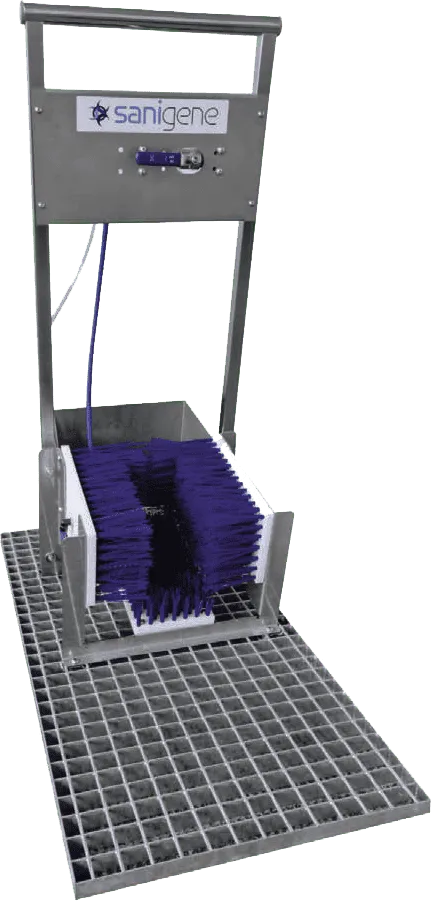
Foot disinfection solutions
Keeping your clean zone clean starts at the door. Our Sanigene HydroGuard range of boot washers, boot scrubbers, boot disinfectors and walkthrough footbaths cleans and disinfects footwear before anyone steps inside. Whether you need a single boot wash station at a shed entry or complete foot disinfection solutions for a site gate, we'll work with you to find the right fit for your traffic, space and services.
We supply equipment to farms, hatcheries, piggeries and poultry operations, food production, processing plants and quarantine areas.
We also supply vehicle disinfection systems, so we can help you plan for both people and vehicles at the same site boundary, with one team who understands how the whole entry point needs to work.
Why footwear is a biosecurity risk
Boots go everywhere your people do, and they bring a lot with them. Soil, mud, manure and other organic material collect in the tread and along the sides, and they can carry weed seeds as well as the bacteria, viruses and fungi behind infectious diseases.
That’s why people moving between zones matter. Staff, contractors and visitors stepping from a paddock, a delivery bay or another property into a clean area are one of the ways disease can get in, and material caught in a boot tread is easy to carry without noticing.
Cleaning and disinfecting footwear at the point of entry helps reduce that risk. Many sites also pair it with dedicated footwear for each zone, which works well alongside a boot wash station rather than in place of one.
Clean first, then disinfect
Disinfectant works best on a clean surface. Soil, manure and other organic matter on contaminated footwear can reduce how well a boot disinfectant performs, so boots need cleaning before the disinfectant solution can do its job. After that, the solution needs to be at the right concentration and stay in contact with the boot for the time the manufacturer specifies.
This is where DIY footbaths tend to struggle. Every pair of boots adds organic matter to the bath, so the solution gets dirtier as the day goes on. Concentration can drift as the bath is topped up or diluted. And the result depends on each person scrubbing their boots properly before they step in, which is hard to rely on when people are busy. Purpose-built equipment helps take the guesswork out of both steps.
Cleaning
Brushes and high-pressure nozzles remove soil and organic matter. Our boot scrubbers use a rotating brush, and our boot washer uses high-pressure nozzles.
Disinfecting
Dosing and spray units apply a foot disinfectant in a consistent, repeatable way. That includes the built-in dosing on our water-connected boot scrubber, the automatic dosing at our walkthrough footbath inlet, and the boot disinfector spray unit.
The footbath's dosing also helps break down some of the dirt, but where boots are heavily soiled, cleaning first still makes a real difference. Contact time and concentration depend on the disinfectant you choose, so always follow the product label and your site's biosecurity plan. We're happy to help you set the equipment up to suit.
Our foot disinfection range
Every site is different, so our range covers both steps, cleaning and disinfecting. Here's how each unit works.
- Cleans and disinfects
Workboot disinfector and boot washer
This unit combines brushes with a low-pressure water spray and a built-in chemical mixer, so it cleans and disinfects boots in the one unit. The brushes are designed to remove dried-on dirt, and it disinfects the sides and top of the boot as well as the sole. Dosing can be adjusted from 1% to 12% to suit your disinfectant, and the stainless steel construction is built for busy entry points.
- Disinfects
Boot disinfector
The Sanigene HydroGuard boot disinfector sprays disinfectant solution over the soles, sides and top of boots, using clean solution each time. It doesn't need a connection to running water. Add your disinfectant solution and place it where you need it. Battery and manual versions are available. Because it doesn't clean, it works best as the second step after boots have been washed or scrubbed.
- Cleans
High-pressure boot washer
This wall-mounted washer uses high-pressure nozzles to remove sand, mineral deposits and animal waste from rubber boots. It connects to mains water, a central washing system or a pressure washer, with working pressure from 5 to 250 bar and flow of 5 to 20 L/min. Made from stainless steel, it suits sectors including food production, pharmaceuticals, slaughterhouses, quarantine areas, hatcheries and agricultural facilities. It cleans only, so pair it with a disinfection unit.
- Disinfects
Walkthrough footbath
The HydroGuard walkthrough footbath is a stainless steel unit for designated site entry points. Automatic chemical dosing at the inlet supports routine footwear hygiene, and the dosing helps break down some of the dirt. At 1,260 x 586 mm, it can form part of a broader biosecurity program across agricultural, livestock and other controlled-access environments.
- Cleans and disinfects
Boot scrubber
The HydroGuard boot scrubber uses a rotating brush to clean the soles and side edges of boots, triggered by a button on the handrail. Choose a dry-cleaning model that needs no water or solution, or a water-connected model with a built-in venturi injector and 11 dosing levels from 0.3% to 14%. It's stainless steel, with a removable access grill, and measures 58 x 46 x 110 cm.
Choosing a boot wash station
The right boot wash station depends on your site as much as the equipment. These questions usually point you in the right direction:
Foot traffic
How many people come through, and how often.
How soiled boots get
Light dust, or caked mud and manure.
Water and power
What's available at the entry point.
Your aim
Cleaning, disinfection, or both.
Footwear
Rubber or leather boots.
The table further down the page shows how the range compares.
Installing a boot wash station at the site entry
Position your unit at the boundary between the dirty and clean zones, so everyone passes it on the way in. A hard, drained surface keeps the area safe underfoot and helps stop mud building up.
Plan for wastewater and top-ups before you install. Think about where runoff will go, and how and when the solution will be replenished. Wastewater requirements vary by site and location, so check yours early. We're happy to talk it through with you.
If vehicles come in at the same point, our vehicle disinfection systems can sit alongside your boot wash station, so people and vehicles are managed together at the one entry.
Features and benefits
Features
- Workboot disinfector and boot washer with brushes and low-pressure spray
- Boot disinfector with no running water connection required
- Wall-mounted high-pressure boot washer
- Stainless steel walkthrough footbath with automatic dosing
- Boot scrubber with rotating brush and handrail push button
- Built-in dosing from 0.3% to 14% depending on model
- Heavy-duty stainless steel construction
Benefits
- Disinfection of soles, sides and tops of boots
- Low disinfectant consumption
- Boots cleaned in seconds
- Removal of dried dirt and organic contaminants
- Inexpensive and effective disease prevention
- Placement anywhere on site
How the range compares
| Unit | Cleans | Disinfects | Water connection | Best for |
|---|---|---|---|---|
| Boot washer | Yes, high-pressure nozzles | No | Yes: mains, central wash system or pressure washer (5 to 20 L/min) | Heavily soiled rubber boots where water is available; pair with a disinfection unit for the second step |
| Boot scrubber | Yes, rotating brush | Yes, on the water-connected model (0.3% to 14% dosing) | Water-connected model only; dry-clean model needs none | Entries that need brush cleaning and disinfection in one step |
| Boot disinfector | No | Yes, spray application | Not required; add disinfectant solution | Entries without running water (battery and manual versions available), used after boots are cleaned |
| Walkthrough footbath | To an extent, with dosing that helps break down dirt | Yes, automatic dosing at the inlet | Yes, water connection access | Designated site entry points in agricultural, livestock and other controlled-access environments (1,260 x 586 mm) |
Frequently asked questions
What is the difference between a boot washer and a boot disinfectant?
A boot washer cleans boots, removing soil and organic matter with water or brushes. Disinfectant is the solution that does the disinfecting, applied by a boot disinfector, boot scrubber or walkthrough footbath. Clean and rinse first, because organic matter can reduce how well disinfectant works.
Does foot disinfection equipment need a water connection?
It depends on the unit. Our high-pressure boot washer connects to mains water, a central washing system or a pressure washer. The boot disinfector needs no running water. The boot scrubber comes as a dry-cleaning model or a water-connected one, and the walkthrough footbath has a water connection.
Where is foot disinfection equipment used?
Farms, hatcheries, piggeries and poultry operations, food production, processing plants and quarantine areas, and anywhere else with controlled access and heightened biosecurity procedures.
Can the chemical dose be adjusted?
Yes, on several units. The water-connected boot scrubber has 11 dosing levels from 0.3% to 14%, and the workboot disinfector and boot washer adjusts from 1% to 12%. We recommend following the disinfectant label for the right concentration.
How often does the disinfectant solution need replacing?
It depends on foot traffic, how dirty boots are and the disinfectant manufacturer's label, so follow the label and your site's biosecurity plan. Cleaning boots first helps keep the solution cleaner for longer, and a visibly dirty solution is a sign it's due for replacing.
Can boot wash stations clean leather boots and shoes?
Our high-pressure boot washer is designed for rubber boots. For leather boots and shoes, what suits depends on the material and the disinfectant, so tell us what your team wears and we'll help you check.
Talk to us about foot disinfection solutions.
Design, supply, install and commissioning delivered as one turnkey package, built to Australian and International Standards. Send us the duty, the site and the timeline, and we'll come back with a proposal.
- Tell us about the job
The site, the application and anything you already have, such as drawings, a protocol or a duty point.
- Our engineering team responds
A member of our engineering team will respond within 24 hours.
- Proposal and concept
A free proposal and concept design, with no obligation.