
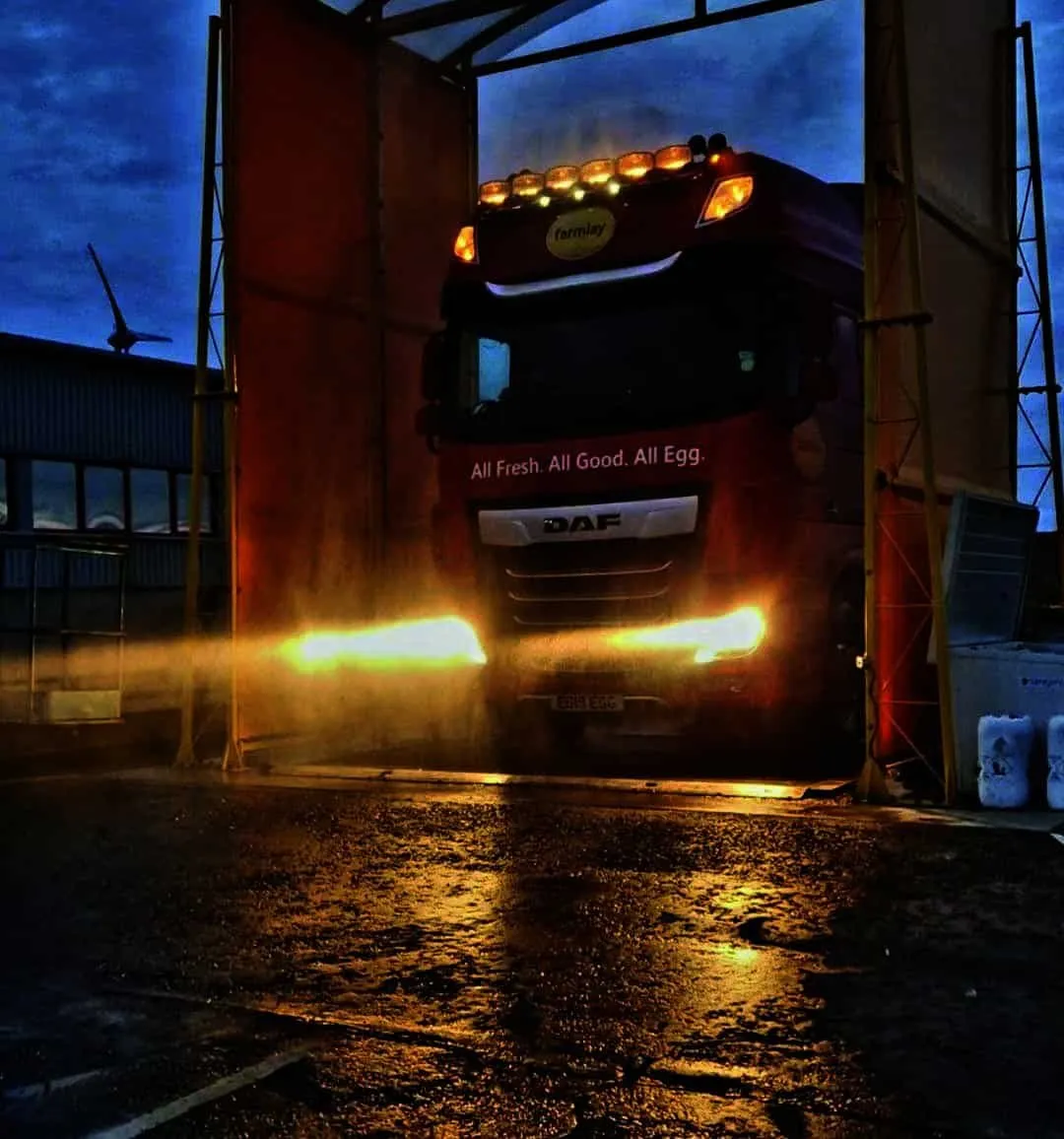
Vehicle disinfection systems
A vehicle disinfection system is one part of a biosecurity entry point, and we help you plan the whole system. Our Sanigene HydroSan range covers 180 and 360 disinfection gates and automatic disinfection tunnels, so you can match the system to the vehicles coming through your gate.
We don’t just supply a gate. As your partner, we work with you to design the entry point as a whole: wash vehicles first, disinfect them, and manage the effluent water that comes off. That suits poultry operations, piggeries, feed mills, dairies and processing plants, where keeping disease off-site is part of how you operate. Tell us about your site, your vehicles and how often they come through, and we’ll help you build an entry point that works for you.
Choosing a vehicle disinfection system
The right system depends on what comes through your gate and how much risk you're managing. These are the main methods that might fit your site, and a few questions help narrow it down.
Your vehicle mix
Is it light vehicles, or every truck on the road? A truck disinfection system for trailers and tall vehicles needs full coverage.
Traffic volume
Busier gates suit automatic systems.
Site risk level
The higher the risk, the more coverage you want.
Staffing
Can you rely on people to spray manually every time?
Power and water
A gate needs a 230 V single-phase supply and cold water at 2 to 5 bar.
Climate
Wind affects spray, and our gates can work below 0°C.
| Method | Coverage | Labour required | Typical site |
|---|---|---|---|
| Wheel bath | Wheels only; a cleaning step, not disinfection | Low | Low-traffic sites, sites that need mud removed from wheels before a gate |
| Manual spray lance | Wherever the operator sprays | High | Small sites, spot treatment, backup |
| 180 disinfection gate | Wheels and chassis | Low, automatic or remote start | Farms, feed mills, vehicles that mainly need wheels and chassis treated |
| 360 DSG disinfection gate | The whole vehicle | Low, automatic or remote start | Higher-risk sites, mixed trucks |
| 360 T automatic disinfection tunnel | The whole vehicle, in two stages (spray, then fog) | Lowest | High-traffic, high-risk sites |
Tell us about your site, and we'll help you with the rest.
Wash first, then disinfect
Disinfection works best on a clean surface. Mud, manure and other organic matter can shield what's underneath and reduce disinfectant performance, so vehicles are best washed before they're disinfected. After that, the disinfectant needs to be at the concentration and contact time the label specifies, and the right product depends on your biosecurity measures and plan, as well as your chemical supplier. We supply the gate, not the chemical, so always follow the label.
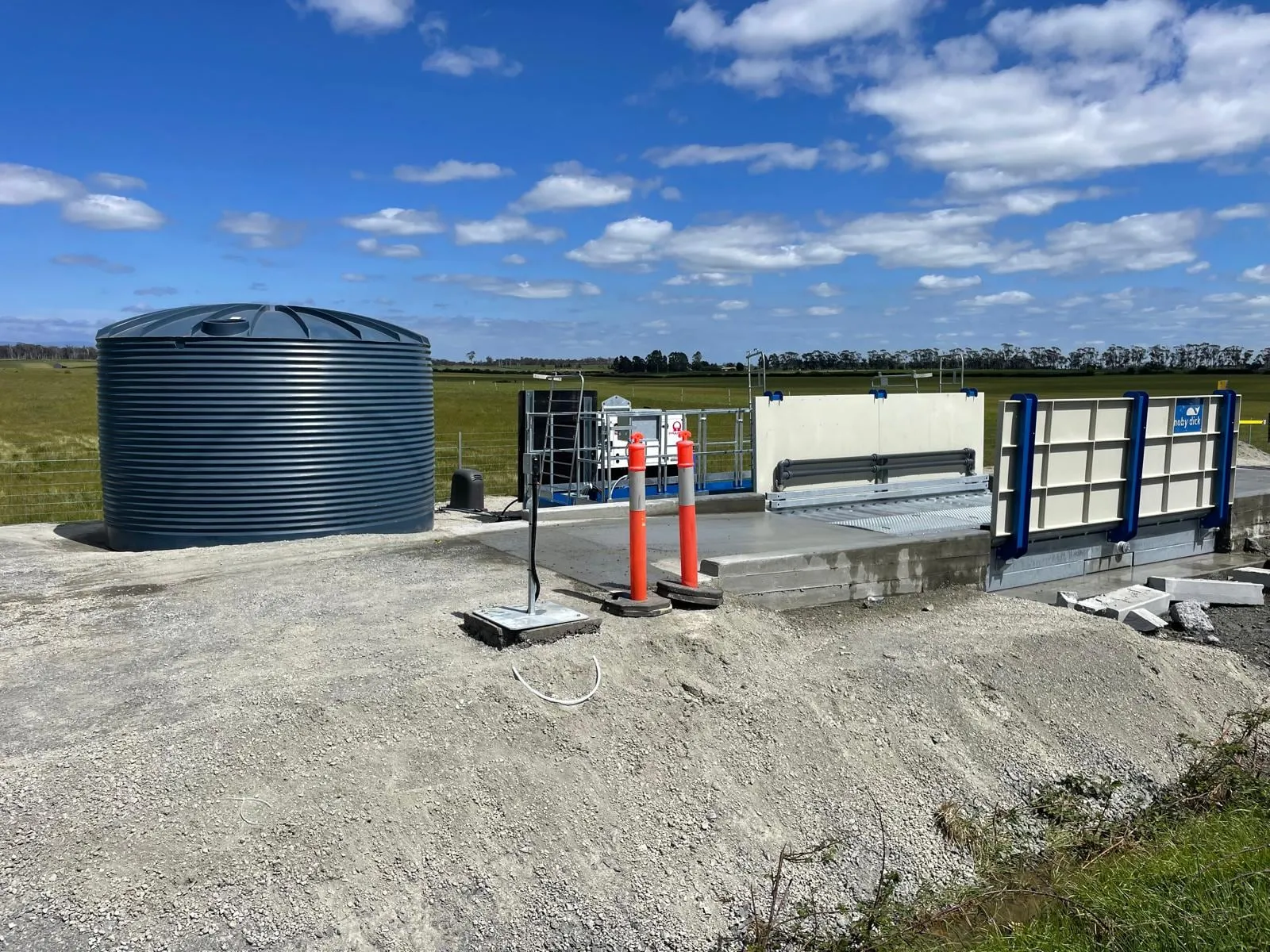
That's why we plan the two steps together. A wheel wash or one of our MobyDick wash systems removes mud from wheels, chassis and underbody, and a disinfection gate then treats a vehicle ready for it. We can pair the two at the same entry point, so vehicles pass through without stopping and starting. Our vehicle wash systems cover the first step, and the water from both can be collected and managed within the same design.
Vehicle disinfection gates
- Wheels and chassis
HydroSan 180
The HydroSan 180 disinfection gate treats wheels and chassis as vehicles drive through. It's 4 m wide as standard (any width is available) and 1.5 m high, with a disinfection time of 15 to 25 seconds per truck and water use of 15 to 50 L/min. It can start automatically via sensors, remotely or manually, and the sensors only pick up metal objects. A built-in dosing system offers multiple dilution levels, and the gate can work below 0°C.
- Whole vehicle
HydroSan 360
The HydroSan 360 sprays the whole vehicle. Its spray posts sit 4.0 or 4.5 m apart, and the gate stands 5.2 m high. The spray is divided into sections, so you can treat the chassis only or the entire truck. A spray lance with a 20 m hose reaches hard-to-reach areas, and the gate is also available as a double gate.
- Draft shield and extended width
HydroSan 360 DSG and 360 W
For windy sites, the HydroSan 360 DSG adds a draft shield made from powder-coated steel and weather-resistant tarpaulin. It helps spread disinfectant evenly over the vehicle and reduces spray drifting outside the disinfection area. The 360 W extends up to 10 m wide where a standard gate isn't wide enough, with overarching sprayers and several sprayers on each line.
- Automatic tunnel
HydroSan 360 T and 360 T Plus
The HydroSan 360 T is an automatic system that sprays the whole vehicle, with extra emphasis on the chassis and wheels. It has chemical dosing, works in low temperatures and warns you when the chemical runs out. The 360 T Plus adds a second stage: after spraying, the vehicle is fogged with disinfectant for a set time to reach hard-to-reach places, inside a disinfection tunnel with roller entry and exit doors. The tunnel acts as a barrier between your clean zone and your dirty zone.
Mobile disinfection sprayers and equipment
Not every entry point needs a fixed gate. Mobile disinfection equipment suits treating vehicles, machinery and equipment by hand, spot treatment between gate stops, and sites where a fixed installation isn't practical. Our range of industrial disinfectant sprayers lets your team treat what a gate can't reach. We supply the equipment, not the disinfectant, so choose your product to suit your biosecurity plan and follow its label.
Venturi disinfection sprayers
A venturi disinfection sprayer uses standard mains pressure, between 2.5 and 10 bar, to draw chemical concentrate into the water stream and blend it on the way through. Dilution is regulated by 12 dosing tips, so your team sprays a ready-to-use solution at a set ratio without mixing it by hand. It uses a low volume of water, which helps keep disinfection efficient. It suits sites with a mains water supply that need a consistent, repeatable way to apply disinfectant.
HydroSan Portable Foamer
The HydroSan Portable Foamer produces well-aerated foam from a ready-to-use solution, using a compressed-air-powered pump. It comes with a hose, stainless steel wand and fan nozzle, with adjustable foam consistency from wet to dry and a large filler opening. Tanks are available in 70 L, 130 L and 200 L, and it suits the food industry.
HydroSan Portable Fogger
The HydroSan Portable Fogger covers larger areas and hard-to-reach places with a cold fog of 16 to 20 micron droplets. An integrated fan and blower extend the mist's reach, fan speed control adjusts how far it projects, and a built-in mixing device keeps the liquid stirred while it runs. It needs no air pressure connection, runs on 230 V or 400 V power and comes with a 130 L or 200 L tank.
For personnel, see foot disinfection solutions, and for weed and seed control on vehicles, see weed seed and biosecurity wash.
Where vehicle disinfection systems are used
Vehicle disinfection suits any site where a vehicle could carry disease in or out. That includes poultry farms and hatcheries, piggeries, dairies, feed mills, abattoirs and processing plants, zoos and veterinary sites. For these, livestock vehicle disinfection at the gate is a practical part of farm biosecurity, because trucks that collect or deliver animals, feed and product move between properties every day.
The same approach suits mining, Defence and quarantine sites, where vehicles and equipment move between areas with different biosecurity needs. Tell us what comes through your gate, and we'll help you choose a system that suits your site and the biosecurity plan you're working to.
Features and benefits
Features
- 360 degree and 180 degree vehicle disinfection gates
- Automatic sensor, remote control or manual start
- Built-in dosing system with multiple dilution levels
- Low-temperature operation below 0°C
- Lightweight powder-coated aluminium construction
- Spray lance with 20 m hose for hard-to-reach areas
- Draft shield, extended width and automatic tunnel options
- Mobile venturi sprayers, foamers and foggers
Benefits
- Disinfection of 100% of vehicles entering site
- Significantly reduced risk of disease entering the site
- Cost-effective protection of the business
- Minimal maintenance
- Visibility after dark with reflective elements
- Bespoke sizes on request
Sanigene HydroSan gate range, as published by AEG
| Model | Coverage | Standard dimensions | Power supply |
|---|---|---|---|
| HydroSan 360 | Whole vehicle | 4 m wide x 5.2 m high | 16 A 230 V single phase |
| HydroSan 180 | Wheels and chassis | 4 m wide x 1.5 m high | 16 A 230 V single phase |
| 360 D with Draft Shield | Whole vehicle | 4 m wide x 5.2 m high x 3 m long | On request |
| 360 W Extended Width | Whole vehicle | 5.2 m high x 4 m internal width (extendable to 10 m) | On request |
| HydroSan 360 T Automatic | Whole vehicle with chassis and wheel emphasis | 4 m wide x 5.2 m high x 3 m long | 32 A 230 V single phase |
Frequently asked questions
What is the difference between a 180 and a 360 vehicle disinfection gate?
A 180 gate treats the wheels and chassis. A 360 gate sprays the whole vehicle, with sections you can switch to treat only the chassis or the entire truck. The right choice depends on your vehicles and the risk level at your site.
What are the installation requirements for a disinfection gate?
A 4 m x 5 m concrete pad, a 1 m x 1.5 m pad for the storage box, a 230 V single-phase power supply (16 A, or 32 A for the 360 T) and cold water at 2 to 5 bar. If this size doesn't suit you, let us know what size you need, and we'll provide options that match your requirements.
How long does it take to disinfect a truck?
The 180 gate takes 15 to 25 seconds per truck. Times for other systems depend on the configuration.
Can the gates operate in freezing conditions?
Yes, it's possible. We can set up our gates as required, and our engineering team will work with you to confirm the configuration your site needs.
Where are vehicle disinfection gates used?
Poultry farms and hatcheries, piggeries, dairies, feed mills, abattoirs, food processing plants, zoos and veterinary sites, where avian influenza and other pathogens are a high risk. The same approach suits mining, Defence and quarantine sites. A disinfection gate can help anywhere a vehicle stops, stopping disease and viruses from moving in or out of your site.
Do vehicles need to be washed before they're disinfected?
Yes, they should be, because mud and organic matter can reduce disinfectant effectiveness. We can pair a wheel wash or wash system with a gate at the same entry point. Once the wash is done, we can also disinfect the effluent water, so the water that carries contaminants off the vehicle is managed as part of the same design. Biosecurity means handling these risks with care, protecting our livestock and crops, and keeping our people safe.
What's the difference between a wheel bath and a disinfection gate?
A wheel dip, or wheel bath, is a drive-through bath that handles the wash-first step. It cleans mud and dirt off the wheels as a vehicle passes through, rather than disinfecting them. A disinfection gate then sprays the wheels and chassis (180) or the whole vehicle (360). Used together, a wheel bath and a disinfection gate cover both steps at the same entry point, and we can quote both to suit your site.
Talk to us about vehicle disinfection systems.
Design, supply, install and commissioning delivered as one turnkey package, built to Australian and International Standards. Send us the duty, the site and the timeline, and we'll come back with a proposal.
- Tell us about the job
The site, the application and anything you already have, such as drawings, a protocol or a duty point.
- Our engineering team responds
A member of our engineering team will respond within 24 hours.
- Proposal and concept
A free proposal and concept design, with no obligation.