
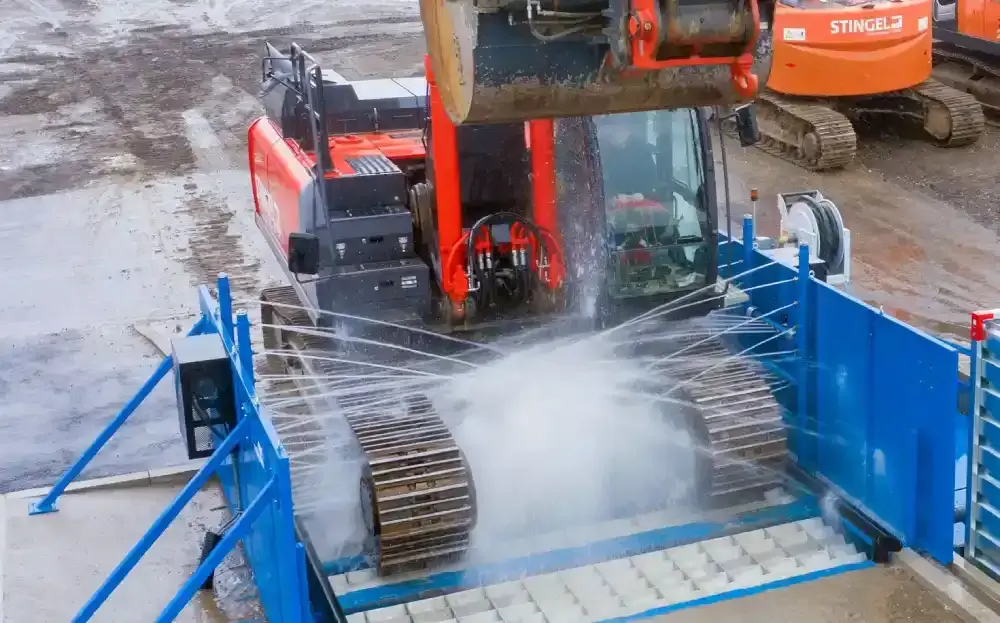
A truck wash that is undersized does not fail on day one. It fails in the first wet month, when soiling triples, trucks queue at the exit, and the recycling pit fills faster than it settles. By then the civil works are poured and the fix is expensive.
The five sizing variables
Every system we design starts with the same five questions. Get any one of them wrong and the bay is either oversized capital or an undersized bottleneck.
- Fleet size and mix. Not just how many vehicles, but how many of each class, and what share are site vehicles versus third-party haulage.
- Vehicle type and axle load. A 40-tonne road truck and a 180-tonne haul truck need different grid ratings, nozzle envelopes and bay lengths.
- Soiling grade. Dry dust, wet clay and sticky overburden behave differently. Clay is the one that decides pump duty.
- Throughput requirement. Peak vehicles per hour at the exit, not the daily total. Shift change is usually the worst hour.
- Site constraints. Available fall, power, water source, footprint, and the discharge limits in your environmental licence.
Why soiling grade matters most
Two sites with identical fleets can need systems a size apart. The difference is almost always the material on the tyres. Dry, granular soil sheds at low pressure in a short dwell. Wet clay packs into tread and wheel arches and needs higher flow, longer contact and more agitation to break it free.
Design for the wettest fortnight of the year. That is when the EPA is watching the road, and when an undersized bay gives up.
Daniel Thompson, Project Delivery Manager and Managing Director
Soiling also drives the settling side of the system. Fine clay stays in suspension far longer than sand, so the recycling pit or clarifier has to be sized for the finest fraction you expect, not the average.
Worked example: hard-rock quarry, Hunter Valley
A quarry exporting crushed aggregate by road, with most of its traffic third-party truck-and-dog combinations leaving through a single weighbridge exit.
| Variable | Site value | Design consequence |
|---|---|---|
| Fleet | ~60 loads per day, 80% third-party | Unattended, drive-through operation |
| Vehicle class | Truck-and-dog, 42.5 t GCM | Heavy-vehicle grid, bay long enough for both units |
| Soiling grade | Dry dust in summer, wet clay fines in winter | Pumps sized on winter clay, not summer dust |
| Peak throughput | 18 trucks in the first hour of shift | Cycle short enough that no queue forms at the weighbridge |
| Discharge limit | No off-site discharge | Closed-loop recycling with settling sized for fines |
The answer here is a single-lane drive-through wheel and chassis wash, pumps selected for the winter clay duty, and a closed-loop recycling system with settling capacity for a full shift of fines. The fleet total barely changed the design. The winter soiling and the first-hour peak decided almost everything.
Specify on peak hour and worst soiling, then check the recycling side can keep up with that duty for a full shift. Most failures are on the water side, not the wash side.
Sizing the water side
Every litre sprayed has to settle, be treated and come back. A system recycling most of its water still needs make-up supply for losses on the vehicle, evaporation and sludge removal. The pit or clarifier must hold enough volume that fines have time to drop out before the water is reused.
- Size settling on the finest particle you expect to carry
- Allow for sludge removal access from day one
- Confirm discharge conditions before the civil design is fixed
Next steps
If you have a fleet list, a site plan and your licence conditions, we can size a system and give you a concept layout. Our vehicle wash systems page covers the system types we design and install.
Frequently asked questions
How many vehicles per hour can a drive-through wheel wash handle?
It depends on the wash cycle and the soiling grade. Drive-through systems are designed around the peak arrival rate at the exit, so we size the cycle so that no queue forms in the busiest hour of the shift.
Do I need a water supply if the system recycles?
Yes. Recycling systems still lose water on the vehicles, through evaporation and with the sludge. A make-up supply, usually a tank or bore, tops the system up automatically.
What happens to the sludge?
Settled solids are removed from the pit or clarifier on a schedule, usually by excavator or sucker truck. The design should give that equipment access from day one.
Can a wash system be relocated when the pit moves?
Modular and temporary systems are built to be moved. Fixed bays with in-ground pits cannot, so the choice depends on how long the exit road will stay where it is.
Send us your fleet and site conditions. A member of our engineering team will come back with a concept.